PROJECT · 2024 — 2025
Cutting lead-gen friction on an industrial AI website
Redesigning and rebuilding Sentics’ marketing site to convert technical buyers, improve performance, and prove impact with a 90-day A/B test.
Role
Lead UX Designer
Timeline
6 months · 2024
Team
Me + 2 developers
Stack
Figma, WordPress, GA4
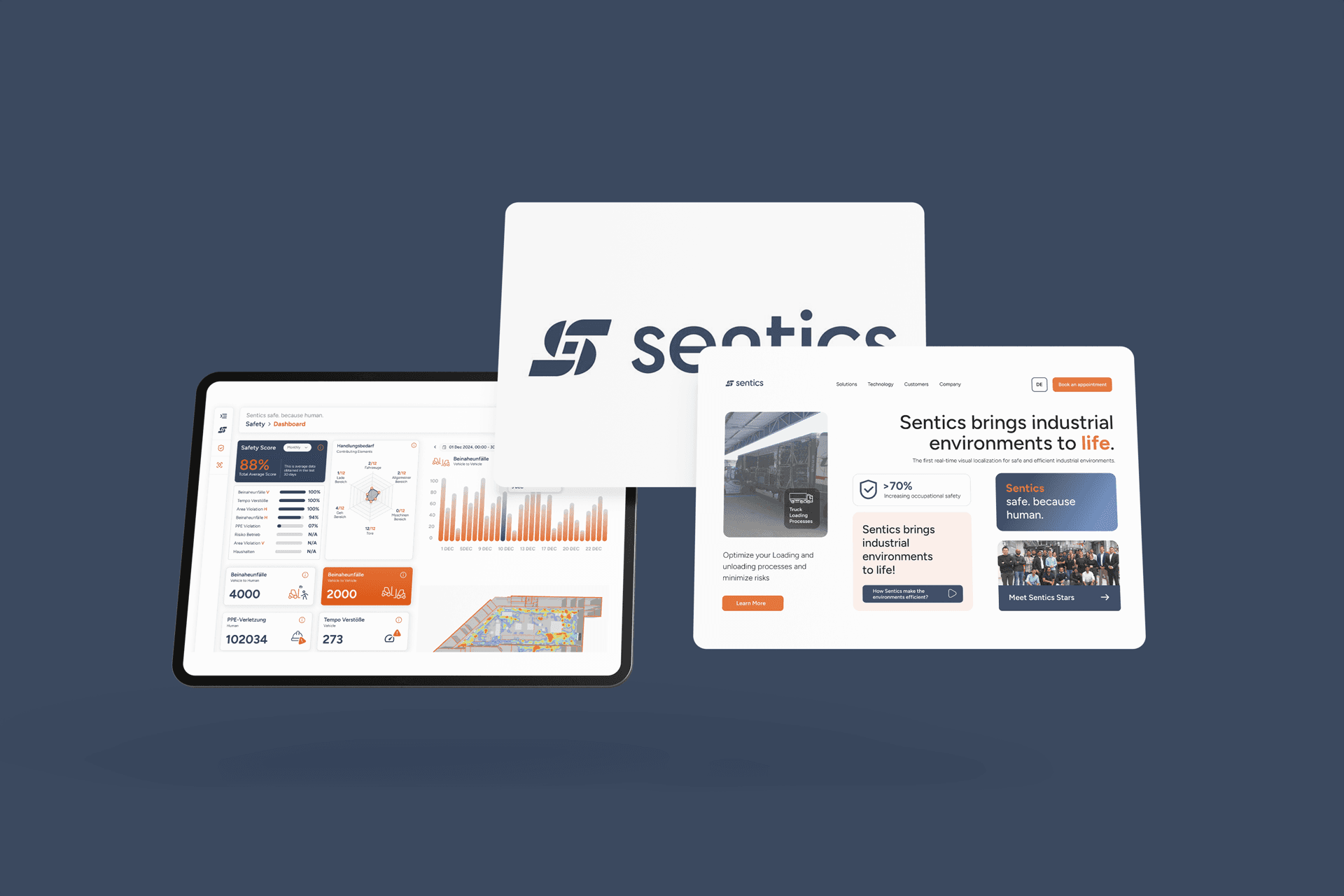
Sentics builds industrial AI solutions for manufacturing teams in Europe. Their website had to earn trust with engineers and procurement leads, not just marketing gloss. My job was to align the story with how buyers actually evaluate vendors — then ship a faster, clearer experience without freezing the business for months.
01 — THE PROBLEM
Sharp visuals, weak conversion paths
Sentics’ previous site looked credible in screenshots, but analytics told a different story: long session paths, weak scroll depth on product pages, and bounce spikes on mobile. Qualified leads were undercounted because forms lived too deep and the narrative jumped straight to technical claims before establishing why the product mattered.
The performance profile was equally costly. Average page load sat around 4.8s on real devices, hurting both SEO and trust for a company selling reliability. Marketing needed velocity — we could not afford a six-month greenfield.
The constraint was legacy WordPress infrastructure already tied to CRM workflows. Whatever we shipped had to migrate without breaking attribution or sales follow-up.
02 — APPROACH
Design for evaluation, then prove it in market
I started by mapping how technical buyers moved from awareness to contact: which proof points they needed at each step, and where the old IA buried them. I paired GA4 paths with Hotjar scroll maps on the worst-performing templates, then reframed the IA around “problem → proof → product depth.”
The principle guiding layout decisions was progressive disclosure: show the minimum credible story above the fold, then invite experts into specs and case studies without forcing everyone through the same funnel.
A conscious trade-off was keeping WordPress as the delivery layer instead of pitching a new stack. That let engineering stay focused on integrations while I owned the design system, component library, and build-ready specs in Figma.
03 — DESIGN DECISIONS
Three bets that moved conversion and speed
Decision 1: Re-sequence the homepage narrative
I moved social proof and sector-specific outcomes earlier, and pushed dense technical content into modular accordions with deep anchors for sharing. The alternative — a long linear scroll of feature blocks — was rejected because it repeated information already in PDFs and datasheets.
This reduced cognitive load for first-time visitors while still giving specialists a path to depth.
Decision 2: Performance budget as a design requirement
I specified image sizes, lazy loading boundaries, and critical CSS priorities alongside visual design. Instead of shipping oversized heroes, we paired art direction with responsive crops and modern formats, targeting measurable LCP improvements on 3G-class connections.
The rejected path was “fix performance later” — in B2B SEO, later never arrives.
Decision 3: Instrumentation before launch
We aligned event naming in GA4 with the A/B test plan so leadership could read the story in one dashboard. I pushed for a 90-day window to smooth weekly noise and capture full sales-cycle length for enterprise leads.
The trade-off was slower headline wins, but much higher confidence in the numbers we reported.
04 — OUTCOME
What changed for the business
+35%
Qualified leads
4.8s → 1.9s
Average page load
90 days
From kickoff to launch
8
Websites optimized
The lift in qualified leads mattered more than raw traffic — we tightened the definition with marketing so we were not celebrating junk form fills. Faster loads supported SEO recovery and reduced abandonment on mobile, where a meaningful share of research happens on the factory floor.
If I repeated the project, I would involve sales earlier on CRM field mapping — we resolved it, but a week upfront would have saved rework on two templates.
05 — REFLECTION
What I learned
This project reinforced that B2B sites win on clarity and speed, not decoration. Pairing UX decisions with a performance budget upfront made engineering a partner instead of a handoff downstream. It also sharpened how I write case studies: lead with the business mechanism, then show the craft that made it possible.